About
us
News
Gallery
Links
History of the regt
Regulations
Uniforms
Weapons
|
The
Festival commemorated 300 anniversary of siege and storm of Narva in the
course of Great Northern War. It was organized by living history group
"Preobrazhensky Life Guard regiment" - it's branches in Narva
and St.Petersburg, by Narva museum with support of Consulate of Russia
in Narva. Reenactors from St.Petersburg and Smolensk, Russia, from Narva
and Rakvere, Estonia as well as one guest from the UK took part in the
event.
For
background of the Festival see
here.
***
 |
LIVING HISTORY CAMP
Most of participants arrived to Narva on Friday noon
and immediately set up the camp: ground in the yeard of Narva castle
was allowed for this; a line of white historical tents with fire
place in front of it, rough wooden tables and benches were placed
next to the fire. Straw, firewood and water was provided by the
hosting side. Territory of the camp was limited by pieces of
historical fortification: gabions, knife-rests and wooden shelters.
Recreation cannons were placed between gabions.
Having finished the camp, we walked around the castle, visited the museum and went downtown.
Later in the evening we cooked our dinner on fire and spent great
time together; many of participants never met each other before and
took this opportunity to get acquainted with fellow-enthusiasts.
Friendly chat around the fire lasted long after midnight: stars and
white giant of castles' Herman tower watched us from their height.
Rain started in the night but it couldn't spoil the cordial
atmosphere: soldiers wrapped in their cloaks and enjoyed the moment
- the moment brought back from three centuries ago. When it came to
going to bed, soldiers went to their tents and had sound sleep on
straw under their coats and cloaks; the drumming rain lulled us to
sleep...
Photos,
part 1 |
|
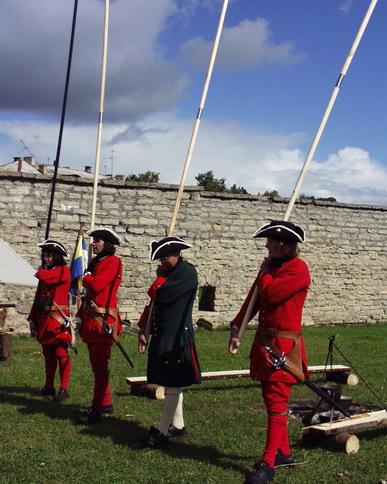
DRILL SESSION
Saturday morning soldiers were issued black powder and were busy with
preparing cartridges and filling their powder-flasks. Pikemen, then, had a
drill session - handling more than 4 meters long pike was not easy for
novices. English mercenary of Russian service Mr.Dave Allen shared his
pikeman's skills. After all, a formation of pikemen on the drill ground
looked not bad. Meanwhile, Narva inhabitants have been gathering in the
castle, curious to see recreated life of 18th century. Sentry grenadier
didn't allow strangers inside the camp but willingly told stories about
military life, uniforms, weapons and so on.
When Swedish artillery arrived from Rakvere, we helped them to disembark
their impressing 6-pounder and were glad to meet the newcomers. Then it
was time for lunch which was provided by organizers and brought into the
camp. Graceful ladies with their cavaliers visited our camp as well - they
were from local 'Theatre of historical costume" and presented their
civilian 18th c. impressions.
After lunch we had general training session for all participants: Russian
infantry formation marched here and there across the castle yard, wheeled
left and right, advanced and withdrew, repulsed imaginary cavalry charges.
Both soldiers and civilians were impressed to see the results of the
training.
Photos,
part 2 |
|
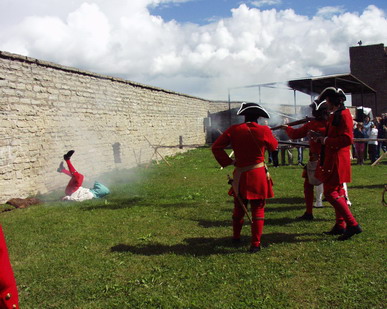 |
DESERTER
An accident happend around Saturday noon: one of soldiers abandoned
ranks and carried with him His Tsar Majesty' issue uniforms and sword. Garrison was
alarmed, patrols of foot soldiers and dragoons were sent out to seek
the deserter. The rogue, as further investigation showed, was trying in
vain to sell his sword or at least change it for beer to local civilians;
after all he was detected by dragoons, was cought but showed forcible resistance,
attempted to escape but was finally brought back to camp under guard.
Nothing could help him to avoind severe but just punishment: court martial
sentenced him to death via firing squad. Bag on head, cold stones of a
wall behind, commands of corporal, clang of muskets being loaded, volley...
Photos,
part 3 |
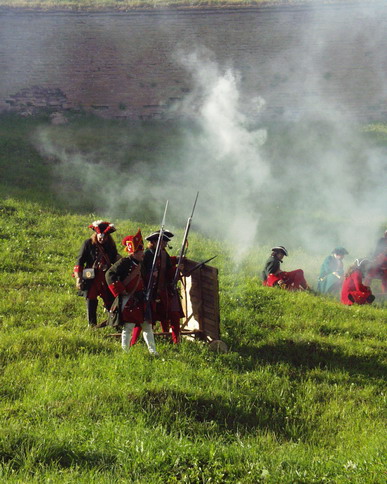
| Battlefield was chosen beneath fortress walls. Swedish
positions were fortified with gabions etc. Attacking Russians were divided
into two groups. One group landed from rowing boats; under heavy
bombardment boats approached shore, soldiers of the landing party fired
from shipboard, while enemy chells were falling in the river here and there
raising columns of water. Once boat's bow touched sand, soldiers
jumped out of boats and advanced towards the foe. After excahnge of fire,
the landing party had to fall back and join main Russian force.
Russian dragoons were reconnoitring enemy positions, from time to time
they closed to Swedinsh outposts; one of charges was unfortunate for a
dragoon - he was dismounted and finished by a Swede.
Artillerymen from both sides worked hard: cannonade roared over the field,
shells and grenades bursted all around and gunsmoke covered the scene from
time to time. Clearly, there were not enough participants to perform
linear tactics: advancing infantry first was occupied with skirmish, then
grenadiers moved forward to throw grenades under cover of transportable
siege shelters. Musketry was crackling non-stop. Eventually Russians
formed a line and marched towards Swedish redoubt, bayonets and pikes were
already lowered as moscovites approached, but - such are fortunes of war -
sudden and powerful volley of Swedish artillery stopped the advance:
formation fell apart and soldiers fled in disorder. Subsequent assault was
more a success and relative historical accuracy, thus, was observed.
At that very moment when we entered the redoubt, heavy shower started
suddenly and both defenders and offenders became wet to skin.
|
WAR
Photos,
part 4
|
|
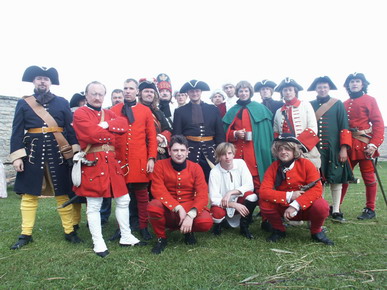
PEACE
Photos,
part 5
|
Under continuing rain we all formed and marched to bastion
Victoria - the one that was breached during the siege of 1704 and where
killed soldiers were burried. Having honored heroes of the past (as we did
before the battle when we saluted to Swedish Lion monument near the castle)
we headed back to the camp. The rain had stopped by then and
fireworks were set up in the castle to celebrate a successful final
of Narva Campaign of 2004.
Party in the camp lasted till it was late in the night - songs were sung
and lively discussions went on about how nice was location of the camp
amid all that historical environment, how warm was reception and how
new and unusual was this event to the participants.
Last night in the bivouac and on Sunday yesterday's soldiers turned back
into men of 21st century, although very excited remembering those couple
days that they spent in 1704.
Last piece of historical meal is eaten, last glass of drink is consumed,
coats are taken off and tents are folded. Everybody left Narva with strong
belief that they will come back, belief that their own fascinating
experience will bring more interest to the period and more reenactors will
come to Narva to make history live again and again. |
|
Boris Megorsky
SPb
16.08.2004 |
|
|
|
|
| Local media about the Festival (in Russian): |
|
|
"Krengolm Prospect"
В Нарве реконструируют сражение русских со шведами |
|
"Youth of Estonia"
Потешные баталии |
|
"Narva"
Беззаветная любовь реконструкторов |
|
|
(с)
Photographs by: B.Megorsky, K.Nagorny, N.Bruckmuller.
Use of these pictures is free, however we ask you to notify
us about such use.
***
top
|